4 At-Home Fitness Checks for Healthy Aging: A Coach's Guide
By Victor Davis, Health Coach, Victory Health & Wellness.
Most people track weight, steps or blood pressure. Far fewer track the abilities that keep life independent: getting out of a chair, catching your balance, getting up off the floor and walking with confidence. Those abilities quietly decline when we stop using them, and they are much easier to protect when you notice the change early.
Here are four simple checks I use as conversation starters with clients. They take about 15 minutes, need only a chair, a timer and a tape measure, and give you a personal baseline to build on.
Before you start: set up for safety
- Have a partner present to time you and stand close by.
- Use a sturdy chair against a wall and stay near a counter you can grab.
- Wear supportive shoes (or go barefoot on a non-slip mat for the floor check).
- Stop if anything hurts or you feel dizzy. Skip any check that does not feel safe today.
If you have fallen in the past year, feel unsteady walking, or are recovering from surgery, skip home testing and talk with your clinician or book a supervised balance and fall-risk assessment.
1. The 30-second chair stand: leg strength
What it shows: lower-body strength and endurance—the muscles you use for stairs, curbs and getting out of the car.
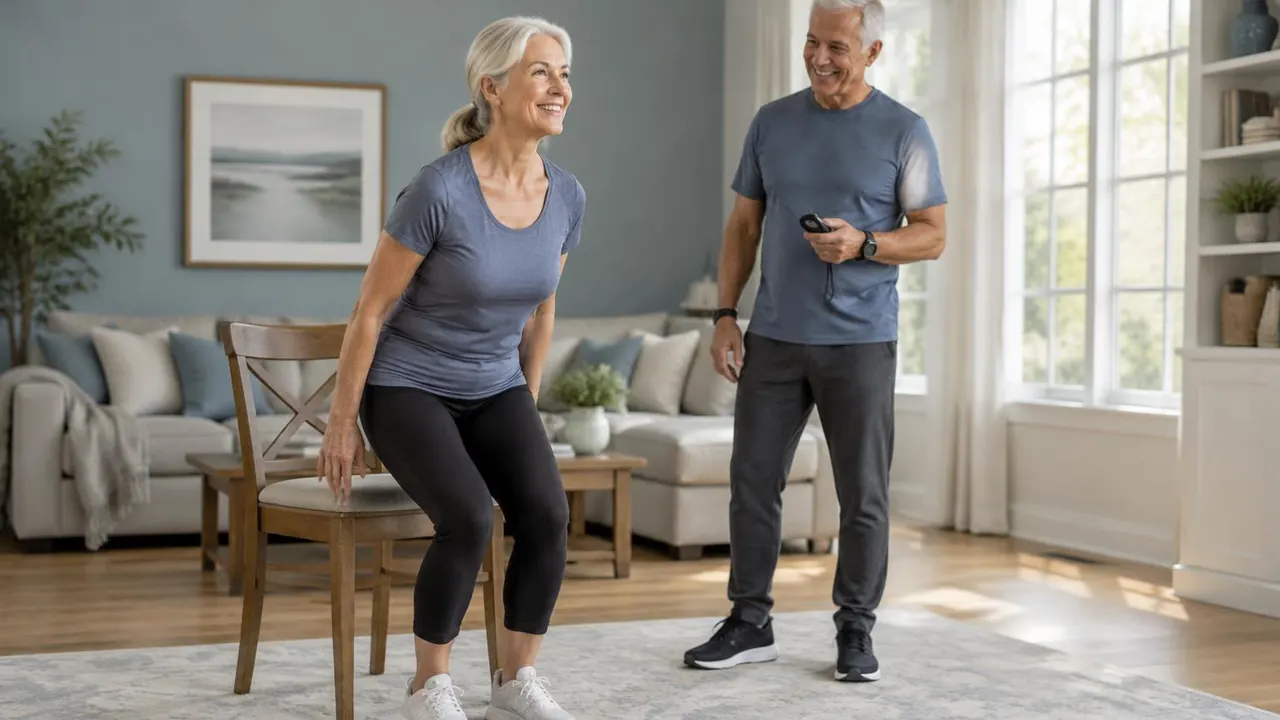
- Sit in the middle of a standard-height chair without armrests, feet flat, arms crossed over your chest.
- On "go," stand fully up and sit fully back down as many times as you can in 30 seconds.
- Count complete stands only.
Researchers developed this test to measure lower-body strength in community-dwelling older adults,1 and the CDC's STEADI fall-prevention program uses it with age-based reference scores.2 Coach's read: if you need your hands to rise, that is useful information. It usually points us toward progressive sit-to-stand and hip-strength work.
2. The one-leg stand: static balance
What it shows: how well your ankles, hips and balance systems hold you steady on one foot—the position you are in with every step.
- Stand next to a counter, feet together, eyes forward.
- Lift one foot and rest it lightly against the back of the other calf.
- Time how long you can hold without touching down, up to 10 seconds. Repeat on the other side.
In a 2022 study of adults aged 51 to 75, people who could not complete a 10-second one-leg stand had a higher risk of death from any cause over the following years than those who could.3 That is an association across a group, not a prediction for you. Coach's read: a big left-right difference is often more useful to me than the total time.
3. The sitting-rising check: whole-body mobility
What it shows: strength, flexibility, balance and coordination working together—the skills you need to get down to the floor and back up.
- On a non-slip mat with room around you, start standing with a chair nearby.
- Lower yourself to sit cross-legged on the floor, then stand back up, using as little support as you comfortably can.
- Start from 10 points (5 for sitting, 5 for rising). Subtract one point each time you use a hand, knee, forearm or the side of a leg for support.
Researchers in Brazil found that lower sitting-rising scores were associated with higher mortality risk in adults aged 51 to 80.4 Coach's read: needing a hand is common, not a failure. The goal is to keep the skill, because being able to get up from the floor matters if you ever do fall.
4. Timed Up and Go: everyday walking mobility
What it shows: how smoothly you combine standing, walking, turning and sitting—basically, moving around your home.
- Mark a line 10 feet from a chair with armrests.
- Start seated. On "go," stand, walk at your normal pace to the line, turn, walk back and sit down.
- Your partner times it from "go" until you are seated.
The Timed Up and Go was first described as a basic test of functional mobility for older adults.5 CDC STEADI notes that taking 12 seconds or longer suggests higher fall risk.2 Coach's read: how you move matters as much as the time—shuffling, a wide stance or hesitation on the turn are all worth mentioning to your clinician.
What your results mean—and what they don't
These checks are screening snapshots, not a diagnosis. They don't tell you why a result is low, and a single good score doesn't rule anything out. Pain, medications, inner-ear or vision changes, neuropathy and many other factors can affect balance and mobility; those questions belong with your physician. Our sister practice, Victory Hearing & Balance, separately provides clinical vestibular care.
What the checks do offer is a baseline. Write your numbers down, date them, and repeat in six to eight weeks under the same conditions.
How to improve: the Lifestyle Medicine Pillars approach
Strength and balance respond to practice. A large Cochrane review found that exercise programs, especially those combining balance and functional training, reduced the rate of falls in community-dwelling older adults.6 The U.S. Physical Activity Guidelines recommend that older adults include muscle-strengthening and balance activities alongside aerobic movement.7
Physical activity is one of the six pillars of lifestyle medicine, which the American College of Lifestyle Medicine describes as foundations of long-term health.8 In practice, I pair movement with the other pillars: enough protein to support muscle, restorative sleep for recovery, and coordinated care with your physician.
Coach Davis's coming-week starter plan
- Three days this week: two sets of sit-to-stands from a chair, stopping two reps before you'd need your hands.
- Every day: practice a one-leg stand at the kitchen counter while the coffee brews, 3 holds per side.
- Twice this week: practice getting down to and up from the floor next to a couch, using whatever support you need.
- Daily: take a walk that includes a few turns and changes of direction.
When to measure more precisely
Home checks tell you how you move. Objective testing can add context about what's underneath:
- InBody 580 body composition scan — estimates muscle and fat by body segment, useful if leg strength feels low.
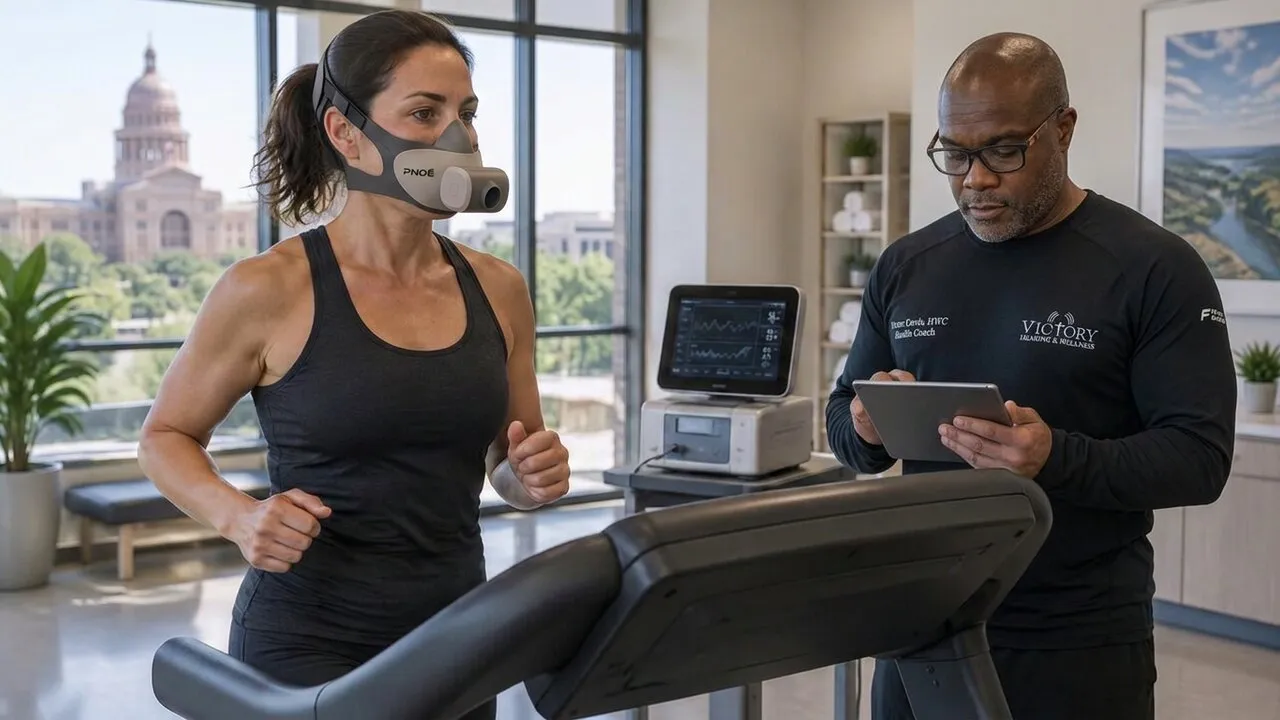
- PNOĒ VO₂ max testing — measures aerobic fitness, another strong marker of healthy aging.
- Balance & fall-risk assessment — supervised testing at our Hutto and West Lake Hills clinics.
Testing is optional. Choose it when it answers a question that changes your plan.
Your next step
Bring your four numbers to a free Victory discovery call. We'll talk through what they suggest, what to work on first and whether healthy-aging coaching, personal training or Victory Yoga fits your week. Coaching is available in person in Hutto and West Lake Hills and virtually nationwide through the Victory Coaching App.
References
- Jones CJ, Rikli RE, Beam WC. A 30-s chair-stand test as a measure of lower body strength in community-residing older adults. Research Quarterly for Exercise and Sport. 1999;70(2):113–119. PubMed: PMID 10380242.
- Centers for Disease Control and Prevention. STEADI: Stopping Elderly Accidents, Deaths & Injuries — clinical assessment resources.
- Araujo CG et al. Successful 10-second one-legged stance performance predicts survival in middle-aged and older individuals. British Journal of Sports Medicine. 2022;56(17):975–980. PubMed: PMID 35728834.
- Brito LB et al. Ability to sit and rise from the floor as a predictor of all-cause mortality. European Journal of Preventive Cardiology. 2014;21(7):892–898. PubMed: PMID 23242910.
- Podsiadlo D, Richardson S. The timed "Up & Go": a test of basic functional mobility for frail elderly persons. Journal of the American Geriatrics Society. 1991;39(2):142–148. PubMed: PMID 1991946.
- Sherrington C et al. Exercise for preventing falls in older people living in the community. Cochrane Database of Systematic Reviews. 2019. PubMed: PMID 30703272.
- Piercy KL et al. The Physical Activity Guidelines for Americans. JAMA. 2018;320(19):2020–2028. PubMed: PMID 30418471.
- American College of Lifestyle Medicine. The pillars of lifestyle medicine. Educational guidance, not evidence of Victory program outcomes.
Safety note: These checks are educational and are not a medical or fall-risk diagnosis. Stop any activity that causes pain, dizziness or shortness of breath, and talk with your physician before starting a new exercise program. Health coaching does not diagnose or treat disease.
FAQ
- Can an at-home fitness check predict how long I will live?
- No. Studies link results on tests like the one-leg stand or floor rise with mortality risk across large groups, but they cannot predict an individual's lifespan. Use them as a personal baseline to guide training, not as a forecast.
- Is it safe to do these checks alone?
- Do them with a partner nearby, next to a counter or sturdy chair, on a non-slip surface. Skip any check that causes pain or dizziness. If you have fallen recently or feel unsteady, get a supervised balance assessment instead of testing at home.
- How often should I repeat the checks?
- Every six to eight weeks is enough to see a real trend. Use the same chair, surface, time of day and footwear so changes reflect your fitness rather than the setup.
- What if my results are lower than I hoped?
- A lower score is a starting point, not a verdict. Strength and balance often respond to consistent, progressive practice at any age. A coach can build a plan around your result, and a clinician should review new or unexplained changes.
Get new articles by email
Grab the free Victory Wellness Guide and we'll send practical health tips and new articles to your inbox.
Ready to work on your health goals?
Our health and wellness team in West Lake Hills, Hutto, and virtually nationwide can build a plan around your goals.