
Know Your Fall Risk Before It Becomes a Problem
A quick, objective balance assessment using validated force-plate technology — measuring your postural sway against normative data for your age and sex, with a full report you and your care team can act on.
Self-pay & FSA/HSA
Wellness, lifestyle, and overall health appointments and services are self-pay. FSA/HSA cards may be used when a service is deemed medically necessary by your provider; we can provide an itemized receipt for reimbursement.
$80 — includes the assessment and full written report.
What Makes This Different
Measured data instead of impressions — and a report that travels with you.
Objective, Not Subjective
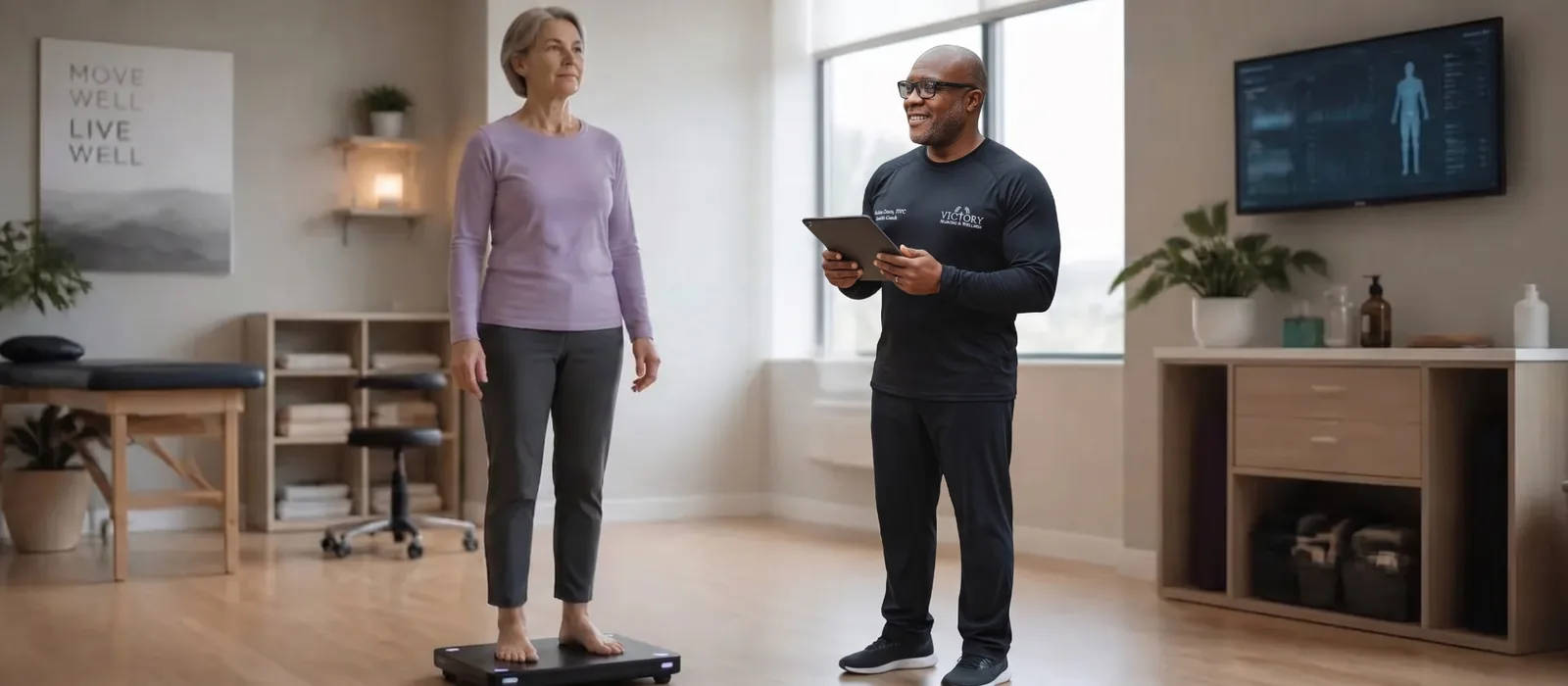
Instead of a visual once-over or a checklist-based balance check, this assessment uses a force plate to precisely measure your postural sway. It's the same category of technology used in clinical and research settings.
Compared to Real Normative Data
Your results are measured against established normative data specific to your age and sex — not a generic pass/fail scale. You see exactly where you stand relative to people like you.
A Report You Can Actually Use
You leave with a full written report you can share with your physician, physical therapist, or audiologist, so your balance data becomes part of coordinated care rather than a one-off number.
What You'll Get
- A precise measurement of postural sway and balance control
- A fall risk classification based on validated, age/sex-normed data
- A written report suitable for sharing with your physician or care team
- A baseline you can retest against to track change over time
Pricing
Transparent, self-pay pricing — no membership required.
Self-pay & FSA/HSA
Wellness, lifestyle, and overall health appointments and services are self-pay. FSA/HSA cards may be used when a service is deemed medically necessary by your provider; we can provide an itemized receipt for reimbursement.
Why This Matters
Falls are a leading cause of injury among older adults, and balance naturally changes over time with age, vestibular issues, and certain health conditions. Because those changes tend to happen gradually, they're easy to miss until something happens. Measuring balance objectively — before a fall — gives you and your care team time to act while there are still plenty of options.
How It Works
Four steps from booking to a report you can share.
Book Your Assessment
Schedule a Balance & Fall Risk Assessment at our Hutto or West Lake Hills clinic.
Step Onto the Plate
A short, guided series of balance tests using the force plate — typically completed in well under 30 minutes.
Get Your Report
Receive a full written report comparing your results to normative data for your age and sex.
Review With Your Coach
Your Victory coach walks through the results and, if appropriate, coordinates findings with your physician or the Victory Hearing & Balance team.
Who This Is For
- Adults concerned about fall risk, balance, or stability
- Clients with dizziness, vertigo, or vestibular symptoms
- Clients recovering from a previous fall or balance-related injury
- Clients in the H.E.A.L.T.H. Program focused on healthy aging and longevity
- Anyone wanting an objective baseline before starting a new exercise or mobility program
Integrates With Your Other Care
Balance and fall risk are closely tied to hearing and vestibular health. Victory Health & Wellness works alongside the audiology team at Victory Hearing & Balance, so when your results point toward a vestibular or inner-ear question, that care is handled by licensed clinicians rather than guessed at here.
This assessment also pairs naturally with the H.E.A.L.T.H. Program for clients focused on healthy aging, strength, and mobility over time.
Balance & fall risk assessment questions
What the assessment involves, what it costs, and how the results fit with your medical care.
- What happens during a balance and fall risk assessment?
- You stand on a force plate through a short series of guided positions and trials while it measures how much your body sways. There is no strenuous activity, no treadmill, and no needles — most people are done in well under 30 minutes.
- Does a balance assessment diagnose a balance or vestibular disorder?
- No. Per the assessment technology's own guidance, the force plate provides objective information about your balance status and should not be used by itself to diagnose any medical condition. It measures and tracks postural stability so a clinician can decide whether further evaluation is warranted — see our Scope of Care page for what coaching does and does not include.
- What does a balance and fall risk assessment cost?
- $80, which covers the force-plate testing session and your full written balance report.
- Does insurance cover a balance and fall risk assessment?
- This is a self-pay wellness assessment rather than a billed medical service. Many clients pay with an FSA/HSA card when their provider considers the assessment medically necessary, and we supply an itemized receipt for reimbursement claims.
- How often should I repeat my balance assessment?
- Every three to six months works well while you are actively training stability, since sway scores are what show whether the work is paying off. Once you are stable, an annual re-check is usually enough.
- Can I bring my balance report to my physical therapist?
- Absolutely. The written report includes your sway measurements and comparison data, which physical therapists, physicians, and audiologists can use to guide vestibular or gait work.
Coaching That Works Alongside Your Healthcare
Coaching is educational and supportive — it works alongside, not in place of, your physicians and licensed providers.
Balance testing across the Austin area
BTrackS testing takes about twenty minutes and runs at both clinics. Our Hutto clinic on E. Wilco Highway is the nearer option for families in Round Rock, Pflugerville, Georgetown and Taylor; our West Lake Hills clinic on Bee Caves Road serves central and west Austin, Rollingwood, Bee Cave and Lakeway. Both have ground-level parking close to the door, which matters when the reason for the visit is unsteadiness.
Because the test produces a number rather than an impression, it is easy to bring adult children or a spouse into the conversation without it becoming an argument about whether someone is "fine". We repeat the test after a training block so the follow-up shows whether the balance work is doing what it should.
Educational content and interactive tools on this site do not provide a medical diagnosis and are not a substitute for evaluation by a licensed clinician. Health, wellness, and lifestyle coaching is educational and is not medical care. Never start, stop, or change a medication based on information here. If you have a medical emergency, call 911.
This assessment provides a means of gathering objective information regarding balance status. This information should not be used by itself to diagnose any medical condition or disease state.
Part of The Whole-Person Wellness Guide
Lifestyle medicine treats nutrition, movement, sleep, stress, connection and substance use as the primary levers for chronic-condition risk — not afterthoughts bolted onto a prescription. Read the full guide for the rest of the picture.
Read the Whole-Person Wellness Guide- Metabolic Intelligence Program
CGM plus AI nutrition coaching, in Austin or virtually across the U.S.
- H.E.A.L.T.H. Program
Tiered coaching for people who want structure and follow-through.
- Functional Lab Testing
Curated panels with results reviewed by our team and translated into a plan.
Keep building stability
Visit a Victory clinic near you
This service is available at both Central Texas clinics, with virtual coaching where it fits.
Victory Health & Wellness — Hutto
201 E. Wilco Hwy., Suite 105
Hutto, TX 78634
Monday–Friday, 9:00am–5:00pm
Victory Health & Wellness — West Lake Hills
3811 Bee Caves Rd., Ste 101
West Lake Hills, TX 78746
Monday–Friday, 9:00am–5:00pm
Serving Austin, Round Rock, Georgetown, Pflugerville, Cedar Park, Bee Cave, Lakeway and Taylor — plus virtual coaching in all 50 states.