What Does an InBody Scan Tell You? An Austin Results Guide

Learn how to read InBody results for body fat, skeletal muscle, visceral fat, body water and segmental balance—plus what to track over time.
An InBody results sheet can feel like a wall of numbers: skeletal muscle mass, percent body fat, visceral fat, segmental lean analysis, body water and an overall score. The useful question is not whether every number falls inside a colored bar. It is what the numbers say together—and which ones should change for the goal you actually have.
This guide explains how to read InBody results without turning one scan into a verdict. An InBody scan estimates body composition using bioelectrical impedance analysis. It gives you a detailed baseline for wellness, nutrition and fitness decisions, but it is not a medical diagnosis and should not replace evaluation by a licensed clinician.
What an InBody scan measures
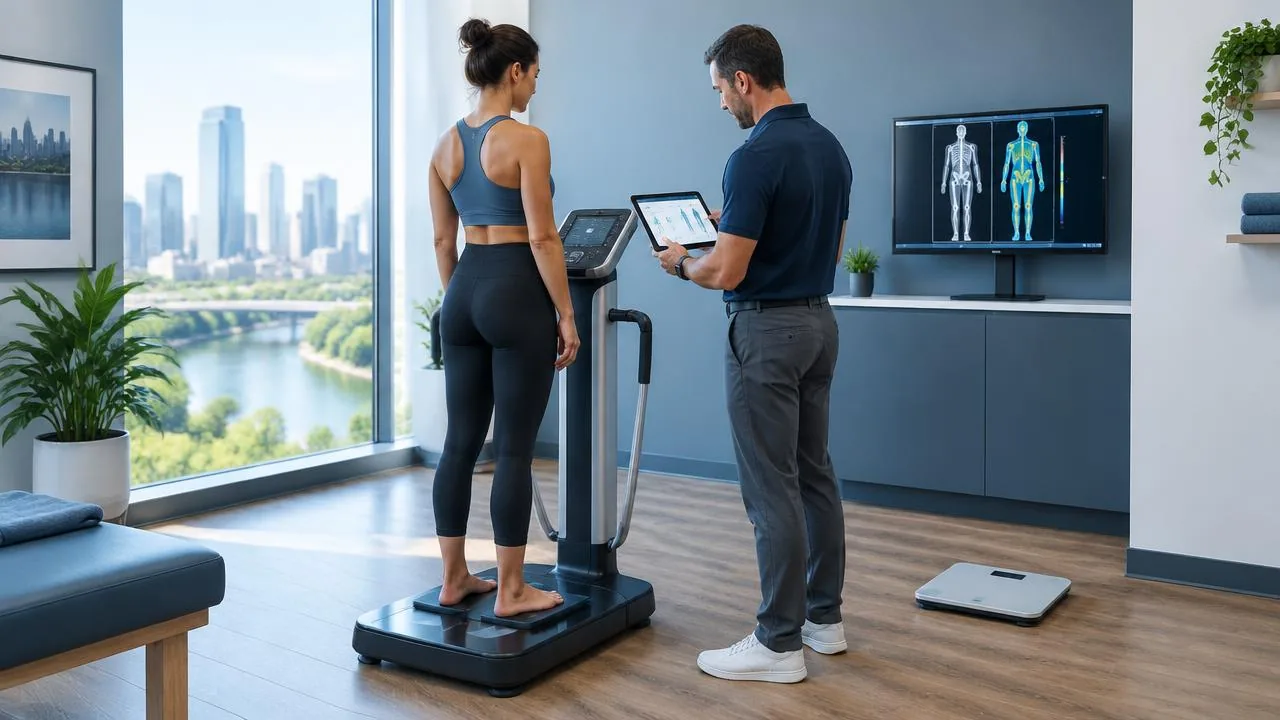
A bathroom scale gives you total weight. An InBody scan separates that weight into several estimated compartments, including body water, lean mass and body fat. The InBody 580 used at Victory also reports how lean mass and fat are distributed across the arms, legs and trunk.
The technology sends small electrical currents through the body and measures impedance—the resistance those currents encounter. Water-rich lean tissue conducts differently from body fat. Measurements at multiple frequencies and body segments are used to estimate the values on your sheet.
That makes the scan useful for questions a scale cannot answer: Did a weight-loss phase reduce fat while preserving muscle? Is a strength program adding lean mass? Are the right and left sides reasonably balanced? Is a sudden change more likely to reflect body water than new tissue?
Start with muscle and fat—not the InBody Score
The overall InBody Score is a simplified summary of body-composition balance. It can help you follow your own trend, but it should not be treated like a school grade or compared competitively with someone else. A single score cannot know your history, training goals or physical function.
Instead, begin with the three bars commonly grouped near the top of the result sheet:
- Weight is the total on the day of the scan. It is context, not the conclusion.
- Skeletal Muscle Mass (SMM) estimates the muscle attached to your skeleton—the tissue most directly affected by resistance training and protein intake.
- Body Fat Mass estimates the pounds of fat in your body.
Read those values together. If weight falls while skeletal muscle holds and body fat mass falls, the trend supports fat loss with muscle preservation. If weight falls but skeletal muscle falls quickly too, the plan may deserve a closer look. If weight stays nearly flat while muscle rises and fat falls, the scale missed a positive recomposition.
Percent body fat adds context to weight
Percent body fat is the proportion of total weight estimated to be fat mass. It is more informative than BMI for many fitness and body-composition goals because it distinguishes fat from lean tissue. Still, it is not a stand-alone measure of health, and the appropriate context differs by age, sex, history and goal.
Pay more attention to the direction across several consistent tests than to one decimal place. A change from one day to the next can reflect water, food and testing conditions. A pattern across six or twelve weeks is far more useful.
Visceral fat is different from the fat you can pinch
Visceral fat is stored deeper in the abdomen around internal organs. InBody reports it as an estimate, depending on the result-sheet configuration. This measure matters because higher visceral fat is associated with cardiometabolic risk, but the scan does not determine whether you have a disease.
For a fat-loss goal, a downward visceral-fat trend can be useful even when waist or scale changes feel slow. If a result is unexpectedly high, use it as a reason to discuss your broader health picture with an appropriate clinician—not as a diagnosis from the scanner.
Segmental lean analysis shows where lean mass is distributed
The segmental section divides the body into the right arm, left arm, trunk, right leg and left leg. It shows estimated lean mass in each area and whether that amount is considered sufficient for the body weight used by the device.
Side-to-side differences can help guide training conversations. A visible difference between legs may be relevant after an injury or during a strength program, but no percentage should be interpreted in isolation. Hand dominance, sport, past surgery, fluid shifts and measurement conditions can all affect the pattern. A coach can use the result to inform exercise selection; a clinician or rehabilitation professional should evaluate pain, weakness or a medical concern.
Body water can explain a surprising result
Total Body Water is divided into intracellular water, found mainly inside cells, and extracellular water, found outside cells. The ECW/TBW ratio describes how those compartments relate. This is one reason preparation matters: bioelectrical impedance depends on body water, and changes in hydration or fluid distribution can shift the estimate.
If several values move in an unexpected direction, check the testing conditions before rewriting your plan. Was this scan later in the day? After a meal? Soon after a workout? During a different point in the menstrual cycle? After travel, alcohol or an unusually salty meal? Those details do not make the scan useless; they tell you whether it is a fair comparison.
Phase angle and BMR need context
Phase angle comes from the relationship between resistance and reactance measured during the scan. It is often discussed as a marker related to cellular integrity and nutritional or physical status. It varies with factors including age, sex, body composition and health status, so it should be interpreted in context and followed as a personal trend rather than chased as a universal target.
Basal Metabolic Rate (BMR) is the sheet's estimate of the energy your body uses at rest. It is not a calorie prescription and it is not the same as total daily energy expenditure, which also includes movement, exercise and digestion. For people who need a more individualized measurement, an indirect-calorimetry breath test can measure resting energy expenditure rather than estimate it from body composition.
How to prepare for a more comparable scan
The best scan is not the one produced under perfect laboratory conditions. It is the one you can repeat under similar conditions. For a useful baseline and follow-up:
- Test at about the same time of day each visit.
- Use the restroom before testing.
- Wait at least three hours after eating.
- Avoid testing immediately after exercise and allow time to recover.
- Maintain your normal fluid intake; do not deliberately dehydrate or overhydrate.
- Remove shoes, socks, heavy accessories and metal jewelry.
- Keep hands and feet free of lotion so the electrodes make consistent contact.
Follow any additional instructions from the person administering your scan. People with implanted electronic medical devices or other relevant medical circumstances should ask their clinician and the testing provider whether bioelectrical impedance testing is appropriate.
How often should you get an InBody scan?
For most weight-management, nutrition or strength goals, repeating the scan every four to eight weeks is practical. Tissue change takes time, while water can change by the hour. Scanning too often encourages people to react to noise instead of a trend.
Use the same device when possible and compare tests taken under similar conditions. A useful review asks: Did body fat move in the intended direction? Did skeletal muscle hold or improve? Did the segmental pattern change? Do the results agree with waist measurements, strength logs, clothing fit and how the plan was followed?
What to do with your results
Your goal decides which numbers matter most:
- Weight loss: follow body fat mass and skeletal muscle mass together rather than celebrating every pound equally.
- Muscle building: watch skeletal muscle and segmental lean trends alongside performance in the gym.
- Healthy aging: use muscle mass, grip strength, balance and functional progress as a broader baseline.
- General wellness: establish a repeatable starting point, then choose one or two behaviors worth changing before the next scan.
The report should narrow your next step, not create ten new ones. If the goal is fat loss with muscle preservation, for example, the useful plan might be consistent protein, two or three resistance sessions each week and a follow-up scan—not a daily attempt to improve every line on the sheet.
InBody scans in Austin and Hutto
Victory Health & Wellness offers the InBody 580 Ecosystem at our West Lake Hills clinic on Bee Caves Road and our Hutto clinic on East Wilco Highway. The visit also includes accurate height, grip strength and blood-pressure measurements. A scan with a printed report is $40; a scan with a health coach review is $80.
Appointments take about 15 to 20 minutes. Review the full InBody scan options and book online, compare InBody, a home scale and DEXA, or explore our broader wellness testing and assessments in Austin.
Sources and further reading
FAQ
- What does an InBody scan tell you?
- An InBody scan estimates how your weight is divided among body water, lean mass and body fat. The result sheet can also show skeletal muscle mass, percent body fat, visceral fat, segmental lean balance, body-water distribution and estimated basal metabolic rate. It is most useful as a repeatable baseline, not as a diagnosis.
- How do I read my InBody results?
- Start with skeletal muscle mass and body fat mass together, then review percent body fat, visceral fat and segmental lean analysis. Use body-water measures to judge whether testing conditions may have influenced the reading. Compare future scans under similar conditions instead of treating one score as a grade.
- How accurate is an InBody scan?
- InBody uses multi-frequency bioelectrical impedance analysis to estimate body composition. Food, hydration, recent exercise, temperature and testing time can shift the result, so consistency matters. The best use is to compare trends from the same device under similar conditions rather than focus on a single decimal point.
- How often should I repeat an InBody scan?
- For most nutrition, weight-management or strength goals, four to eight weeks gives enough time for a meaningful trend to develop. Very frequent scans can magnify normal day-to-day changes in water and food weight. Your testing schedule should match the pace of your goal and plan.
- Where can I get an InBody scan in Austin?
- Victory Health & Wellness offers InBody 580 scans by appointment at its West Lake Hills clinic on Bee Caves Road and its Hutto clinic on East Wilco Highway. A scan with a printed report is $40, or $80 with a health coach review.
Ready to work on your health goals?
Our health and wellness team in West Lake Hills, Hutto, and virtually nationwide can build a plan around your goals.